

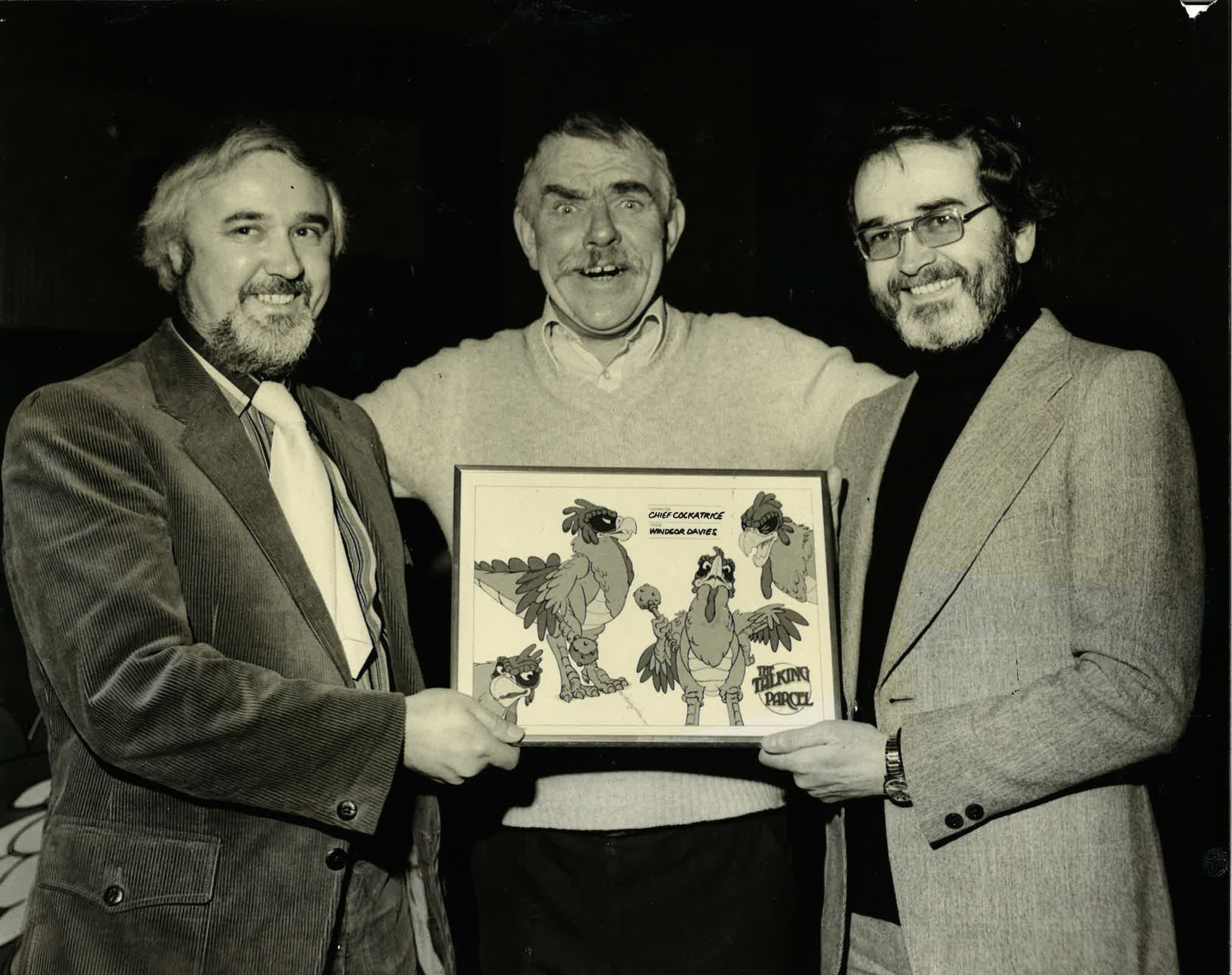
Mark Hall, Windsor Davies and Brian Cosgrove. Image courtesy of Brian Cosgrove
Brian Cosgrove and Mark Hall first met whilst studying at Manchester Regional College of Art and Design (now Manchester Metropolitan University). Mark was studying illustration and Brian was studying graphic design.
In 1957 Brian and Mark reunited, working in the graphic design department at ITV’s Granada Television, where they both produced graphics for a range of television programmes including local News, documentaries and quiz shows. Granada Television was set-up in Manchester in the early 1960s as a regional offshoot of ITV covering the North West of the UK, expanding the output of television production in the area.
It was at Granada using a rigged up 16mm Bolex camera that Brian made his first experimental film The Canary. In 1971, backed by Granada, Brian and Mark first collaborated and produced the animated series The Magic Ball (1971-72). The Magic Ball was the pair’s first creative venture and led to a fruitful collaboration for years to come.
In 1971 Mark Hall, followed by his friend Brian Cosgrove left Granada to form their own independent company Stop Frame Animations. Stop Frame Animations made commercials, short films and series throughout the early seventies including, Sally and Jake for Rainbow (1972) and Noddy (1974). In pursuit of more creative freedom both Cosgrove and Hall decided to leave Stop Frame Productions behind, they detached themselves from Granada Television for the time being and signed a deal with Thames Television.
Cosgrove Hall Films, was established on the 1st January 1976 in Manchester. The founders resisted moving their studios to London, John Hambley joined the team as Chief Executive, handling all the necessary updates to Thames Television leaving Brian and Mark to focus on film production, their real passion. The studios were established on Albany Road in Chorlton-Cum-Hardy, starting with a staff of seven, they converted an old tobacco and sweet warehouse into a makeshift studio and began production of their first series. Over the next quarter of a century, the studio produced some of the best popular children’s shows specialising in both hand drawn, and stop motion animation. Brian oversaw the majority of the hand drawn side of the studio and Mark oversaw the stop motion side of the studio.

Brian Trueman, Terry Scott, Dangermouse, David Jason and Edward Kelsey. Image courtesy of Brian Cosgrove
In a short span on time Cosgrove Hall had grown from a small independent studio into a centre for animation in the North West. A new section was added to the studio in 1984, doubling the size of the building and the studio's capacity.
During the 1980s the company employed around 120 young creatives, animators and artists who entered through schools and colleges. Mark and Brian assembled creative teams, who trained up new animators, model-makers who gained experience on the job and brought their raw talent, leading to a highly skilled, collaborative and creative energy at the studio. Within ten years Cosgrove Hall won three BAFTA awards, an American Emmy, the Prix Jeunesse marking the studio’s success and had become one of the largest European Animation Studios.
Danger Mouse was one of Cosgrove Hall Films’s biggest success and achieved international fame and its own spin off Count Duckula. According to Brian Cosgrove the show ran for one hundred and sixty one episodes achieving phenomenal viewing figures of 24 million.
Cosgrove Hall Films produced quality animation by bringing together some of the biggest talents, puppet-makers, actors and animators in the UK to create some of the best loved characters in children’s animation, Danger Mouse, Count Duckula and The Wind in the Willows. The studio brought characters from popular childhood fiction to life in animations such as Roald Dahl's The BFG (1989), Kenneth Graham’s The Wind in the Willows (1983), and Terry Prachett’s Truckers (1992). They also revived and adapted animations of Noddy, Postman Pat and Bill and Ben in the 1990s and early noughties.

Mark Hall, Image courtesy of Brian Cosgrove
The studio closed its doors for the last time in 2009, the television landscape had drastically changed with the rise of satellite broadcasting. Despite this, the legacy of the studio is monumental. Hundreds of creatives in the North West had worked for the studio in some capacity, many of whom branched out into their own ventures. Mackinnon & Saunders was set up by Ian Mackinnon and Peter Saunders in the early 1990s. HOT Animation was started in the late 90s by Jackie Cockle, Brian Little and Joe Dembinski.
Cosgrove Hall Films ensured that Manchester would be remembered as a centre for animation.
Founder Mark Hall sadly passed away in 2011, he is remembered fondly by all those that worked with him including Brian Cosgrove who has been instrumental in helping bring this archive to Waterside Arts Centre so that the public can once again enjoy the puppets, the animations and the stories behind the people who brought them to life.
“To see a sequence of drawings that you have produced - and you can remember every pencil line you made - to see them filmed and coloured and matched with a voice track - to see you have created something, up there on the screen, that is, to all intents alive - that makes all the madness worthwhile.” - Brian Cosgrove, A Cosgrove Hall Story (2018)
Postman Pat: Special Delivery Service
In 2003 Entertainment Rights and Cosgrove Hall Films teamed up to develop Postman Pat: Special Delivery Service. The stop motion series revived Ivor Wood's original animated series written by John Cunliffe. Reusing parts of sets and expanding the world to include the town of Pencaster. Entertainment rights wanted to preserve the timeless quality of the show introducing subtle changes in design which gave the show a contemporary feel.
Cosgrove Hall Films introduced lip-sync, dialogue, seasons and an abundance of vehicles for Pat to travel back and forth from the sorting office, Greendale and across Pencaster. The series first aired on the BBC in 2008, the production was then taken on by Classic Media, Dreamworks and Mackinnon & Saunders between 2013 - 2017.